



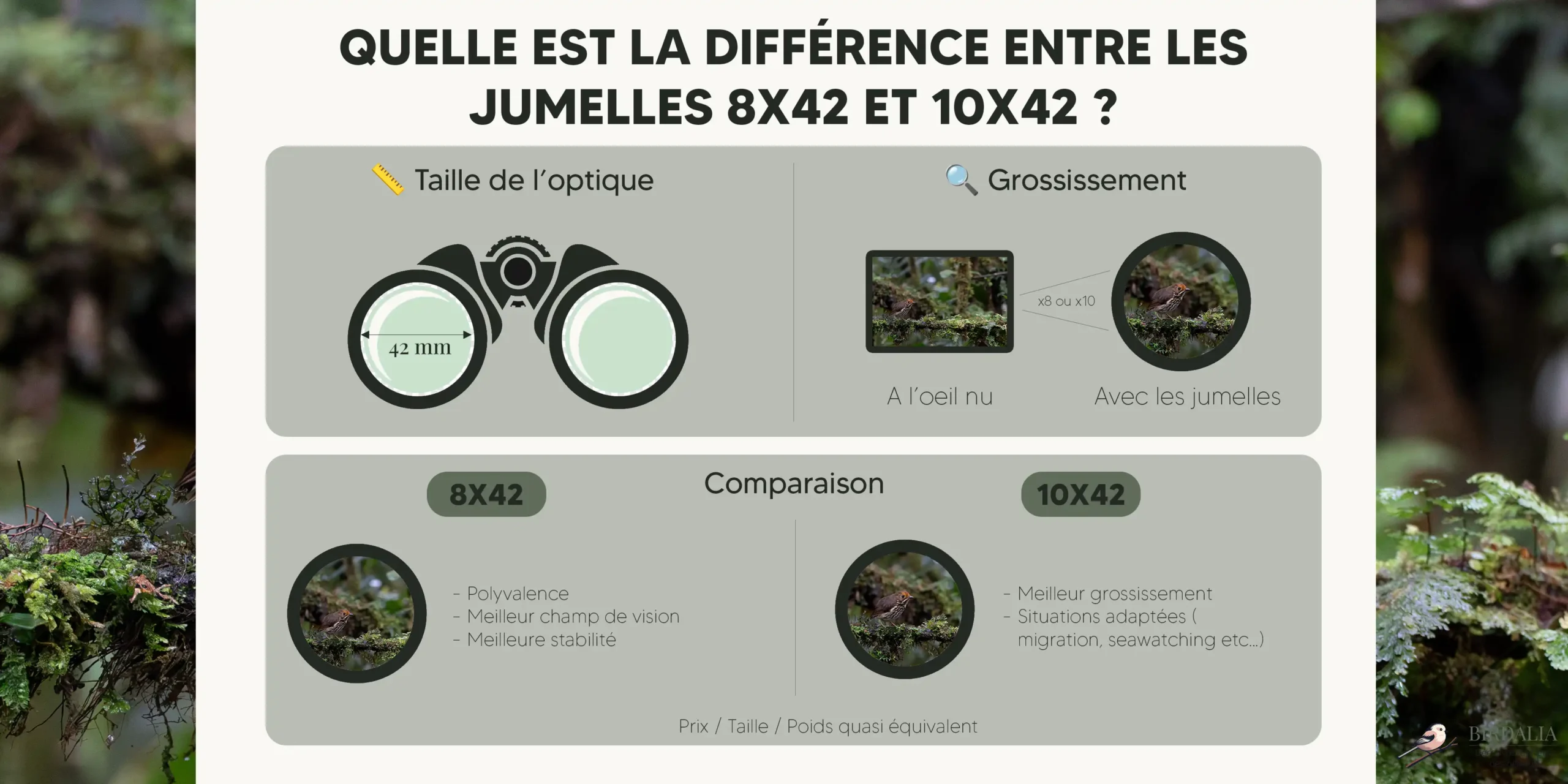
8×42 or 10×42 Binoculars for Birdwatching ?
When I started taking birdwatching a little more seriously, my first pair of binoculars was an 8×42. For several years, they accompanied me everywhere, whether on local outings or during my travels. Then came the time to replace them. After years of use, they had finally reached the end of their life, and the question arose: should I buy another pair of 8×42 binoculars or switch to 10×42?
While looking for information, I quickly realised that this debate is everywhere in the birdwatching world. Some birders prefer 8×42 binoculars, while others consider 10×42 models essential. Honestly, there is no single “best choice” between the two. It all depends on how you use them. This article aims to summarise my research on the subject and share my experience after using both formats in different situations. Hopefully, it will help you make your choice.
What do 8×42 and 10×42 mean?
First of all, a little context. What exactly do 8×42 and 10×42 mean? What do these numbers refer to? The explanation is quite simple.
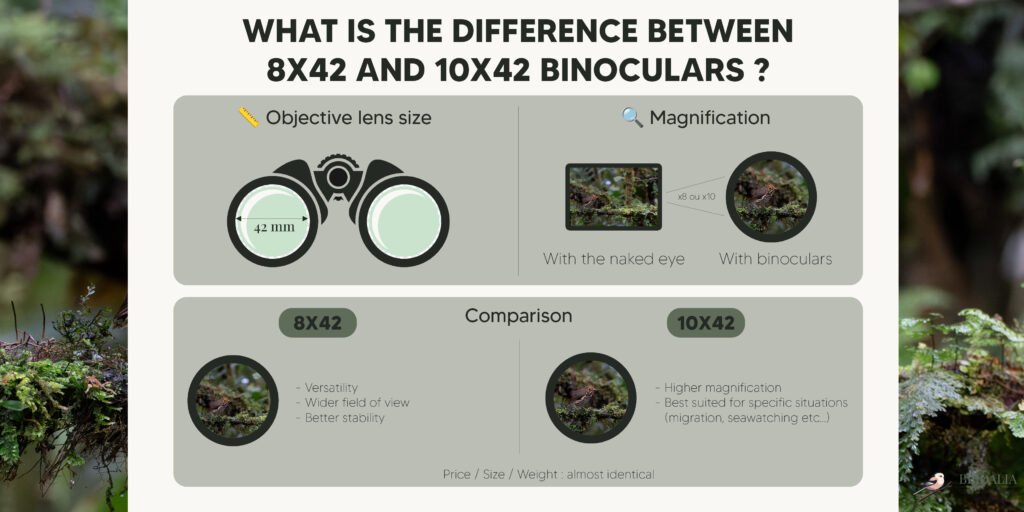
The first number refers to the magnification:
- 8x means that the observed object appears eight times closer than it does with the naked eye.
- 10x signifie que l’objet observé apparaît dix fois plus proche qu’à l’œil nu.
The second number refers to the diameter of the objective lenses, in millimetres:
- 42 mm in both cases.
In short, a 10×42 provides more magnification than an 8×42, while both models have the same objective lens size. On paper, you might think that choosing the highest magnification is the obvious choice. In practice, things are a little more nuanced.
Pros and Cons of 10×42 Binoculars
Pros 10×42
The main benefit of a pair of 10×42 binoculars is obviously the higher magnification. It allows you to see certain details more clearly when birds are far away. This makes them particularly useful in situations where birds are distant or when you need to identify specific details.
The increase in magnification is around 20 to 25% compared with an 8×42. It may not sound like much on paper, but the difference is noticeable in the field. When you spend several hours looking for plumage details to age a bird or trying to read a ring, that extra magnification is definitely welcome.
Cons 10×42
The first drawback is often stability. The higher the magnification, the more your movements are amplified. Hand shake becomes more noticeable, and the image can appear less stable, especially when it is windy or after several hours of walking.
When it comes to size and weight, you might assume that 10×42 binoculars are larger and heavier. However, if you compare an 8×42 and a 10×42 from the same brand and range, the difference is almost non-existent. The main body of the binoculars is generally the same for both models. The 10×42 may be slightly heavier because its lenses are a little thicker to provide the higher magnification, but we are sometimes only talking about a difference of a few dozen grams.
Another point to consider is that it is generally a little harder to quickly find a bird with 10×42 binoculars. Because the field of view is slightly narrower, locating a moving passerine in a tree or following a bird constantly changing perches can take a little more practice.

Kite Optics – Binoculars Kite Ursus 10×42
URSUS is a versatile and easy-to-use pair of binoculars designed for everyday use.
Pros and Cons of 8×42 Binoculars
Pros 8×42
The main advantage of 8×42 binoculars is their versatility. They are well suited to a wide range of situations.
Because the magnification is lower, the wider field of view is also a major advantage of 8×42 binoculars. Birds are easier to find through the binoculars, as you can see more of the surrounding environment and locate the bird before focusing on it.
Brightness is also slightly better with 8×42 binoculars. In broad daylight, the difference is almost impossible to notice, but in lower light conditions, such as at sunrise or sunset, 8×42 binoculars can have a small advantage. This is partly due to the larger exit pupil, which is the diameter of the beam of light leaving the eyepiece and reaching your eye. Of course, this comparison is only meaningful when comparing binoculars from the same brand and product range.
Cons 8×42
The main drawback is obvious: lower magnification. When birds are far away, details are less visible than with 10×42 binoculars. This is not necessarily a problem for everyday birdwatching, but it can become limiting in certain specific situations.
Kite Optics – Binoculars Kite Ursus 8×42
URSUS is a versatile and easy-to-use pair of binoculars designed for everyday use.
Situations where 8×42 binoculars excel
The 8×42 is often considered the most versatile choice for one simple reason: it performs particularly well in the situations that many birders encounter on a regular basis.
This is especially true:
- In forests
- In parks
- During general birdwatching walks
In these environments, birds are often close and move quickly between branches and foliage. The wider field of view helps you locate a bird quickly and keep it in your binoculars. For someone who mainly goes birdwatching in forests or relatively enclosed habitats, an 8×42 is often the most logical choice.



Situations where 10×42 binoculars excel
The 10×42 has the advantage in several situations:
- Migration watching (raptors, passerines, etc.)
- Seawatching
- Shorebird watching
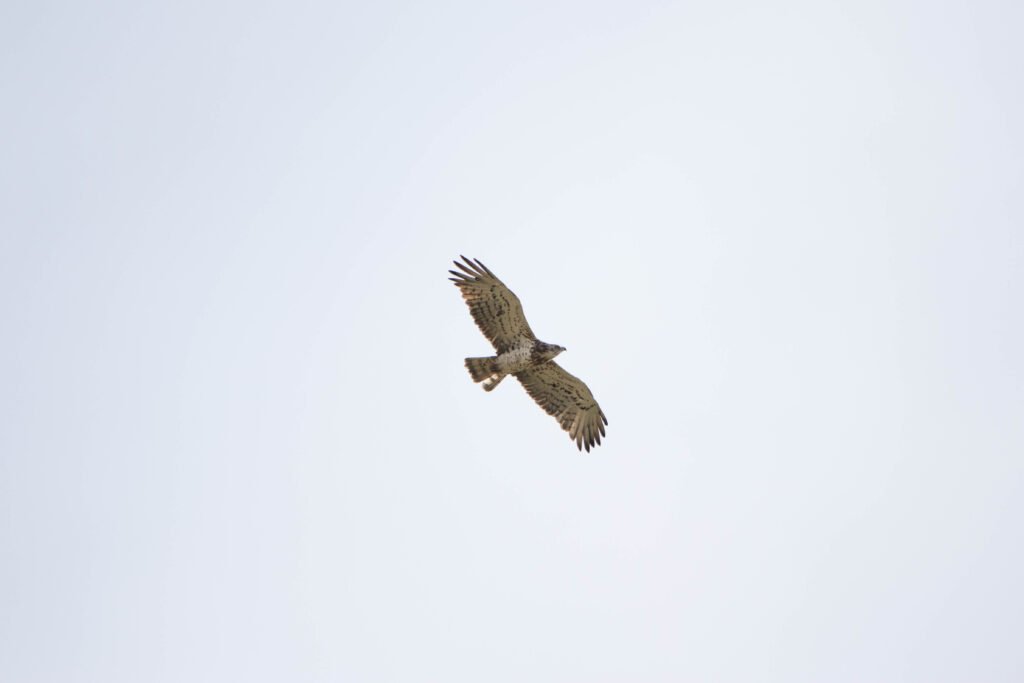
In short, 10×42 binoculars are particularly useful in large, open environments. For example, when birds are flying high overhead, the extra magnification makes it easier to identify them and appreciate details and silhouettes. When watching seabirds from the coast, every bit of magnification is welcome. Birds are often distant, and conditions can sometimes be challenging. On estuaries, mudflats or large bodies of water, viewing distances are often considerable. A 10×42 can therefore make identification easier if you do not have a spotting scope.
A pair of 10×42 binoculars can sometimes allow you to distinguish a ring or other details that would be more difficult to see at lower magnification.


Conclusion
Comparing 8×42 and 10×42 binoculars
After using both formats, I don’t think there is a universal answer.
Many factors are almost identical, including weight, size and even price. I haven’t mentioned price in the previous sections, but an 8×42 and a 10×42 from the same brand and range generally cost the same. There is often only a difference of $10 to $40 in favour of the 10×42, which is fairly insignificant when buying a good pair of binoculars.
When it comes to factors such as brightness or hand shake, the difference is small but can tip the balance one way or the other. For example, if you experience significant hand shake or regularly go birdwatching in low-light conditions.
Ultimately, the choice mainly depends on how you go birdwatching. If you mostly observe birds in varied environments, during walks or in forests, an 8×42 is probably the most versatile option. If raptor migration watching or seawatching plays an important role in your birding trips, then a 10×42 is definitely worth considering.
My opinion: 8×42 or 10×42?
Personally, I started with a pair of Nikon Prostaff 7S 8×42 binoculars and have now switched to Kite Optics Ursus 10×42. I personally haven’t noticed any real difference in brightness. With my 10×42 binoculars, I can also manage the hand shake and narrower field of view when looking for birds.
In practice, I don’t feel limited by using 10×42 binoculars, and I appreciate having the extra magnification to observe more details on birds. For me, the advantages outweigh the drawbacks.
It is also worth noting that a number of experienced birders now choose other binocular sizes, such as 8×32 models. The reduction in weight and bulk becomes much more significant, which can be particularly welcome when travelling or spending long days in the field.